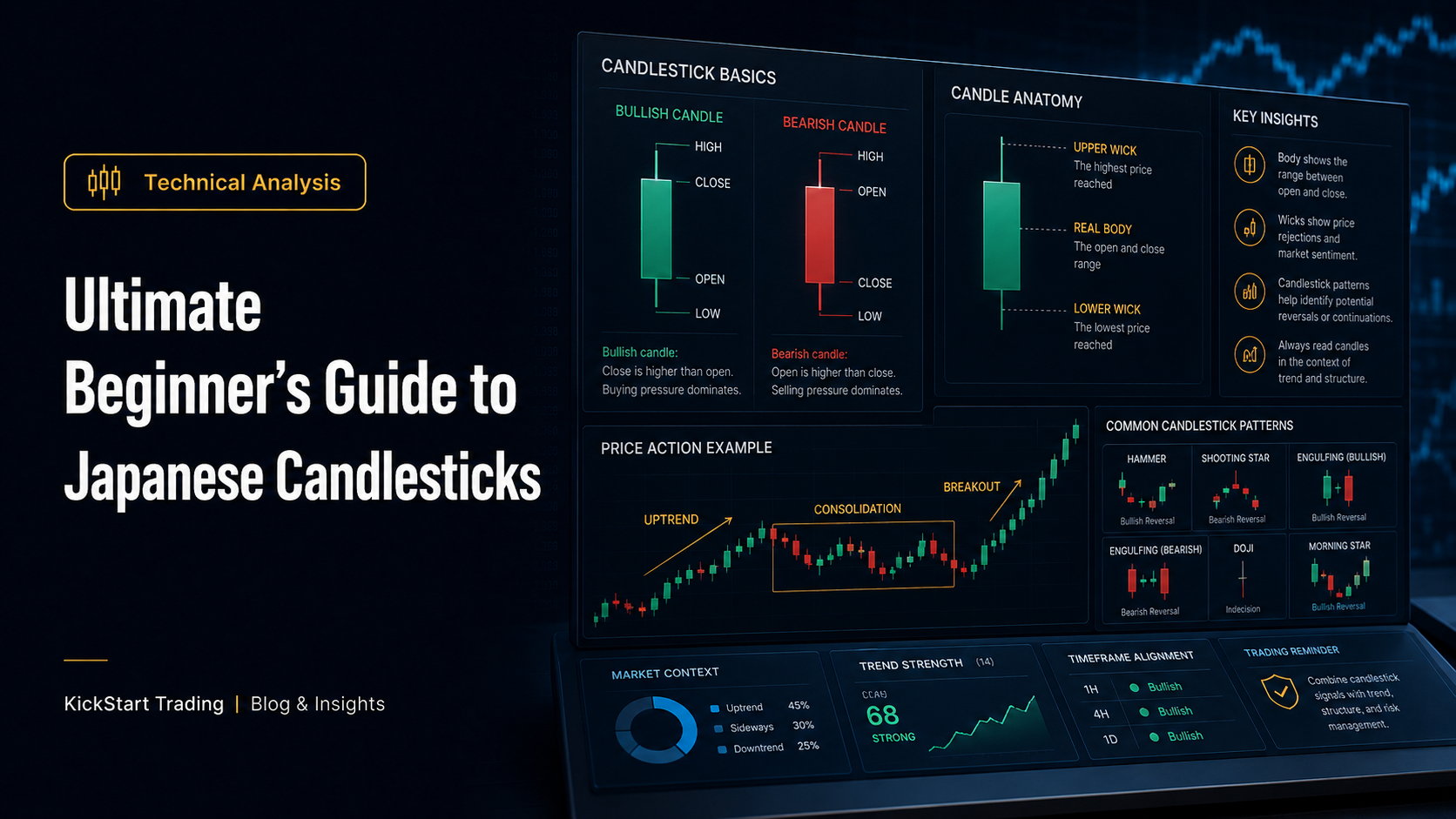
Japanese candlesticks are one of the most important foundations in technical analysis.
Before a trader can properly understand advanced strategies, complex price action, Fibonacci, market structure, or funded trading execution, they need to understand what price is doing at the most basic level.
Candlesticks help traders see the battle between buyers and sellers.
They show where price opened, where price closed, how far price moved, and whether buyers or sellers controlled the session.
That makes them far more than just shapes on a chart.
They are a visual record of market behaviour.
What is a Japanese candlestick?
A candlestick usually shows four pieces of information:
- The open price
- The close price
- The high price
- The low price
The body of the candle shows the distance between the open and close.
The wicks show how far price moved beyond the body before the candle closed.
A bullish candle usually means price closed higher than it opened.
A bearish candle usually means price closed lower than it opened.
That sounds simple, but the meaning behind each candle can be powerful.
Why candlesticks matter
Candlesticks help traders understand pressure.
A large bullish candle can suggest strong buying pressure.
A large bearish candle can suggest strong selling pressure.
A candle with a long wick can suggest rejection, hesitation, or a failed attempt to push price in one direction.
A small-bodied candle can suggest indecision.
The key is not to memorise candle names in isolation.
The key is to understand what the candle is telling you about the market.
Context matters
A candlestick pattern on its own is not enough.
A bullish candle in the middle of nowhere may not mean much.
A bullish candle rejecting a major support area after a strong move lower is far more meaningful.
A bearish rejection candle at resistance may matter more if it lines up with market structure, Fibonacci, or a previous supply area.
This is why traders should avoid treating candlesticks like magic signals.
Candlesticks are evidence.
They should be read in context.
Common beginner mistake
Many new traders try to memorise every candlestick pattern:
- Doji
- Hammer
- Shooting star
- Engulfing candle
- Morning star
- Evening star
- Pin bar
There is nothing wrong with learning those patterns.
But memorisation without understanding can lead to poor trading decisions.
A trader should ask:
- Where did the candle form?
- What happened before it formed?
- Did it reject a key level?
- Did it break structure?
- Did it confirm or contradict the wider market context?
- Does the potential trade offer acceptable risk?
That is how candlestick analysis becomes useful.
Candlesticks and trader psychology
Every candle represents decisions.
Someone bought.
Someone sold.
Someone entered too early.
Someone exited in panic.
Someone got trapped.
Someone waited patiently and executed well.
When you look at a chart, you are not just looking at price.
You are looking at human behaviour expressed through price.
That is why candlesticks remain so useful.
They help traders read emotion, pressure, and intent.
How KickStart teaches candlesticks
At KickStart Trading, candlesticks are taught as part of a complete trader development framework.
They are not treated as isolated signals.
They are connected to:
- Market structure
- Trend analysis
- Support and resistance
- Fibonacci retracement and extension logic
- Risk management
- Trading psychology
- Trade planning
This is how traders begin to move from random chart reading to structured analysis.
Final thought
Japanese candlesticks are not a shortcut.
They are a language.
The better you understand that language, the more clearly you can read what the market may be telling you.
For beginner traders, candlesticks are one of the best places to start.
Learn them properly.
Study them in context.
Use them as evidence.
Then build the rest of your trading framework around structure, risk, discipline, and patience.
Next step
The best way to continue is to watch the free KickStart training and begin building your foundation properly.