Fibonacci is one of the most misunderstood tools in trading.
Some traders treat it like magic.
Others dismiss it completely.
The truth is more practical than either extreme.
Fibonacci can be a powerful tool when it is used as part of a structured trading framework.
It can help traders measure price movement, identify areas of interest, plan entries, define risk, and project potential targets.
But Fibonacci should never be used blindly.
It is not a signal by itself.
It is a framework for structure.
What is Fibonacci in trading?
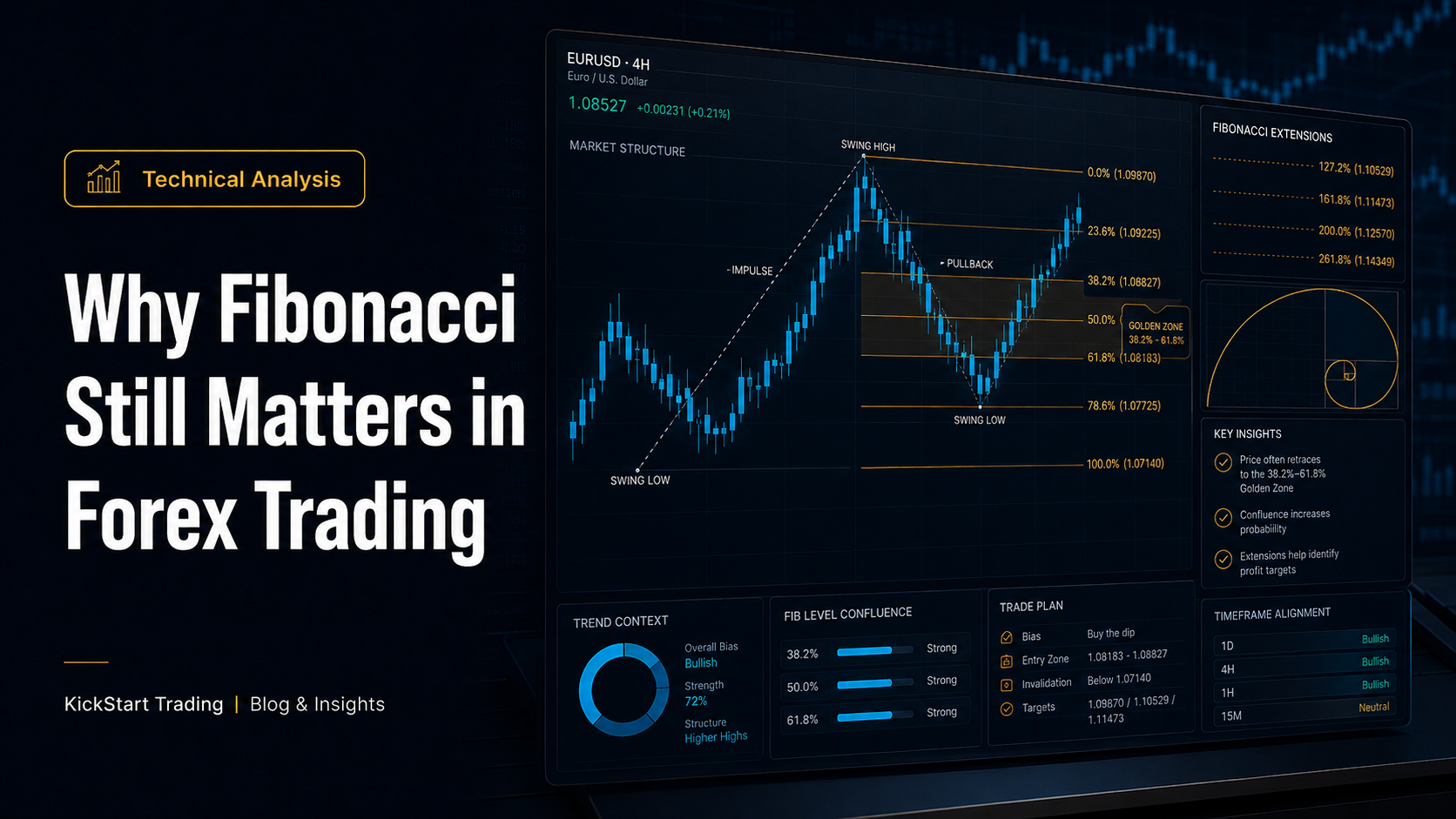
In trading, Fibonacci tools are commonly used to measure retracements and extensions.
A retracement helps traders analyse how far price pulls back after a move.
An extension helps traders project possible target areas after price resumes movement.
The most common Fibonacci retracement levels include:
- 23.6%
- 38.2%
- 50%
- 61.8%
- 78.6%
- 86%
The most common extension levels include:
- 1.14
- 1.18
- 1.27
- 1.618
- 2.618
Different traders use these levels in different ways.
At KickStart Trading, Fibonacci is taught with a structured relationship between retracement zones and extension targets.
That structure matters.
Why traders use Fibonacci
Markets do not move in straight lines.
Price expands, pulls back, consolidates, rejects, continues, and reverses.
Fibonacci gives traders a way to measure those movements.
Instead of guessing whether a pullback is shallow, moderate, or deep, the trader can use Fibonacci to map the move with more precision.
This helps with:
- Identifying potential reaction zones
- Planning trade entries
- Measuring risk
- Projecting targets
- Avoiding emotional decisions
- Creating consistent analysis
The point is not that price must obey Fibonacci.
The point is that Fibonacci helps a trader create a plan.
Fibonacci and market structure
Fibonacci becomes more useful when it lines up with market structure.
For example, a retracement level may be more meaningful if it also aligns with:
- A prior support or resistance level
- A trendline
- A supply or demand area
- A candlestick rejection
- A structural break
- A previous swing high or swing low
This is where beginner traders often go wrong.
They draw Fibonacci on a chart, see price touch a level, and assume that is enough.
It usually is not.
Fibonacci should be used as one layer of evidence.
The problem with random Fibonacci
Many traders draw Fibonacci from random highs and lows.
Then they wonder why the levels do not work.
The tool is only as useful as the structure behind it.
A trader needs to know:
- Which swing matters?
- What is the trend context?
- Has the market created a clean impulse?
- Is price correcting or reversing?
- Does the Fibonacci zone align with anything else?
- Is the risk-to-reward profile acceptable?
Without those questions, Fibonacci becomes decoration.
With those questions, Fibonacci becomes analysis.
Why Fibonacci still matters
Fibonacci still matters because traders still need structure.
They need a way to avoid emotional guessing.
They need a way to define zones, targets, and invalidation.
They need a way to build repeatable plans.
That does not mean Fibonacci is perfect.
No tool is.
But when it is used properly, Fibonacci can help traders think more clearly and plan more consistently.
How KickStart approaches Fibonacci
KickStart Trading has always placed strong emphasis on Fibonacci-based technical analysis.
The system taught through KickStart links specific retracement behaviour to specific extension logic, helping traders think in terms of structured movement rather than isolated levels.
That approach is designed to help traders understand not just where price may react, but how the move itself can be measured, planned, and managed.
The goal is not to predict with certainty.
The goal is to build a repeatable framework.
Final thought
Fibonacci is not magic.
It is not a guarantee.
It is not a shortcut.
But it is still one of the most valuable tools a trader can learn when it is taught properly.
Used with market structure, candlestick analysis, risk management, and discipline, Fibonacci can help traders bring order to the chart.
And in trading, structure matters.
Next step
To go deeper into structured technical analysis, start with the free KickStart training or explore The Ultimate Forex Trading Course.